Publicaciones
Científicas
Rethinking the movement ecology of Andean bears: temperature-driven cathemerality and seasonal space-use cycles
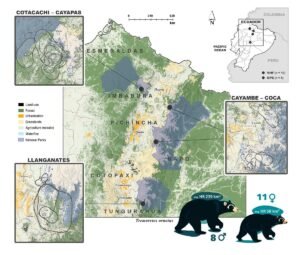
The Andean bear (Tremarctos ornatus), South America\'s only ursid, is one of the world\'s most elusive large mammals, making movement data collection exceptionally rare. Addressing this gap, we present the largest telemetry dataset ever assembled, spanning 19 individuals tracked across three Ecuadorian National Parks over two decades, paired with a novel analytical approach. We integrated Continuous-Time Movement Models (CTMM), Autocorrelated Kernel Density Estimators (AKDEs), Hidden Markov Models (HMM) and a diel niche theoretical framework to mitigate biases previously unaccounted for the species in telemetry studies. Fine-scale AKDEs and non-linear movement metrics were calculated to understand seasonal space use and movement behaviors. Speed and diffusion from CTMM and behavioral states from HMM were modelled with environmental covariates to investigate which conditions shape diel and seasonal activity. Population mean home range was 138.2 km2 (95% Confidence Intervals 78.7-225.5), with males (239.8 km2; 182.8-307.5), significantly exceeding females (58.5 km2; 35.5-90.3). Notably, three females exhibited ranges comparable to some males. Weekly and monthly AKDEs uncovered cyclic home range dynamics potentially driven by resource availability, with contractions around corn harvests, mortino and achupalla fruiting, and expansions during paramo transitions. Decoupling speed from diffusion rates showed region-specific behaviors: intensive patch exploitation in Llanganates, broad exploratory ranging in Cayambe-Coca, and suppressed female locomotion in Cotacachi-Cayapas. Statistical analyses identified temperature as a key diel modulator and precipitation as the seasonal driver. Foraging probability increased between 2:00-6:00, large displacements between 7:00-14:00, and nocturnal movement rose significantly under colder conditions. Across diel hypothesis frameworks, bears were classified as cathemeral rather than strictly diurnal, corroborated by camera-trap records from Colombia, Ecuador, and Peru. We propose a cathemeral diel phenotype that responds to thermal fluctuations and situates Andean bears within a broader ursid context of thermoregulatory niche plasticity. This dataset reveals unprecedented resolution of regional and sex specific behaviors that will facilitate and accelerate comparative studies in rapidly changing Andean landscapes. By releasing this long-term dataset as an open resource, we provide a foundation for climate-resilient conservation strategies. More broadly, we advocate for data democratization and invite collaboration.
Mamíferos grandes y medianos en Ecuador: recomendaciones para su captura y manejo / Capture and management of medium and large mammals in Ecuador: guidelines and recommendations
La ecología, evolución y comportamiento de los mamíferos presentan numerosos aspectos poco comprendidos. En Ecuador, los esfuerzos de investigación a gran escala todavía son limitados, lo que subraya la necesidad de realizar estudios más profundos. Los estudios de campo a largo plazo son fundamentales para abordar los desafíos de conservación de diversas especies; no obstante, la recopilación de datos esenciales se ve frecuentemente obstaculizada por las dificultades asociadas a la captura y marcaje de los animales. En la última década, los sistemas de seguimiento por satélite han revolucionado la investigación sobre los mamíferos medianos y grandes al permitir el monitoreo en tiempo real de sus movimientos. Sin embargo, a pesar de los avances tecnológicos, la captura y liberación de animales, especialmente tras la colocación de dispositivos de seguimiento, todavía enfrenta importantes desafíos logísticos y prácticos. En este artículo, compartimos nuestras reflexiones sobre los procesos de captura y colocación de collares en mamíferos de tamaño mediano y grande, fundamentadas en nuestra experiencia con 107 individuos que hemos capturado, marcado y liberado con éxito. Nuestro objetivo final es proporcionar directrices prácticas basadas en estas experiencias para facilitar futuros esfuerzos de investigación de campo.
A novel genotype of Babesia microti-like group in Ixodes montoyanus ticks parasitizing the Andean bear (Tremarctos ornatus) in Ecuador
Babesia species (Piroplasmida) are hemoparasites that infect erythrocytes of mammals and birds and are mainly transmitted by hard ticks (Acari: Ixodidae). These hemoparasites are known to be the second most common parasites infecting mammals, after trypanosomes, and some species may cause malaria-like disease in humans. Diagnosis and understanding of Babesia diversity increasingly rely on genetic data obtained through molecular techniques. Among hard ticks, several Ixodes species are known vectors of Babesia microti-like species in the Northern Hemisphere. Recently, Ixodes and Amblyomma ticks have been recorded parasitizing the Andean bear (Tremarctos ornatus) in Ecuador. Previous reports have suggested babesiosis in a fatal case of this threatened bear species in that country. This study aimed to detect Piroplasmida DNA in hard ticks collected from Andean bears at two sites in Ecuador. This species plays a critical role as an ecological engineer and a seed disperser, contributing significantly to the maintenance and health of Andean ecosystems. Twelve ticks were screened with conventional PCR and Piroplasmida DNA was amplified from one Ixodes montoyanus tick collected from a free-living female Andean bear at Llanganates National Park. Two Babesia sequences were characterized: one for the 18S ribosomal rRNA gene and another for the cytochrome c oxidase 1 gene. Phylogenetic analyses for both loci placed these sequences within the B. microti-like clade. This study reports a novel B. microti-like genotype identified in an I. montoyanus parasitizing a female Andean bear, contributing to the knowledge of the diversity of this group in South America. Given their conservation status, future epidemiological surveillance of Babesia and other tick-borne infectious agents in Andean bears is needed.
Effects of the Ecuadorian Andes on genetic structure of the spectacled bear with new genetic datasets
The Andes arguably contains the most important biodiversity hot spot (Tropical Andes) in the worldand is home to the only extant bear (spectacled bear, Tremarctos ornatus), in South America. Twomolecular population genetics studies of the spectacled bear were recently carried out in Ecuador.However, these studies had contradictory results, which could hinder the development of an adequateconservation program for this species. To resolve this issue, we analyzed three molecular data setsrepresenting a broad geographical sampling effort. The sets included six mitochondrial (mt) genesof 127 specimens, complete mitogenomes of 43 specimens, and seven nuclear DNA microsatellitesof 88 specimens. The main results were as follows. (1) The mt genetic diversity levels obtainedfor the six mt gene data set were high and identical to the estimates of the two previous studiesregardless of whether specific mt primers for this species were used. (2) The analysis of the six mtgenes and mitogenome data revealed genetic heterogeneity among the spectacled bear samplesof different Ecuadorian provinces, including significant heterogeneity between the northernmostand southernmost Ecuadorian areas. However, this heterogeneity is relatively small. (3) The geneticdiversity levels with heterologous microsatellites were undifferentiable from the genetic levelsreported with homologous microsatellites in a previous study. (4) Analysis of the microsatellite data setindicated a more significant spatial structure than previously reported. Up to seven different geneticclusters were detected but mixed in different areas of Ecuador. However, when they were analyzed atthe province level only one unique genetic cluster was supported. (5) Based on these data, we suggesta single management plan for the entire spectacled bear population in Ecuador rather than a differentmanagement plan for each small spectacled bear population as suggested elsewhere. (PDF) Effects of the Ecuadorian Andes on genetic structure of the spectacled bear with new genetic datasets. Available from: https://www.researchgate.net/publication/395795891_Effects_of_the_Ecuadorian_Andes_on_genetic_structure_of_the_spectacled_bear_with_new_genetic_datasets [accessed May 17 2026].
Social behavior of the Andean bear in northern Ecuador
Record of canine distemper virus in an Andean bear, Colombia
Data: A pilot study on the home range and movement patterns of the Andean Fox Lycalopex culpaeus (Molina, 1782) in Cotopaxi National Park, Ecuador - Copy
This study reports movement patterns and home range estimates of an Andean fox (Lycalopex culpaeus) in Cotopaxi National Park in Ecuador, representing the first GPS-tagging of the species. The GPS functioned well during the 197-day tracking period. Home range sizes ranged between 4.9 and 8.1 km2, depending on the estimation method. Movement speeds averaged 0.17 km/h at day versus 0.87 km/h at night, and distance traveled averaged 0.23 km at day versus 0.89 km at night. These preliminary results highlight the importance of collecting unbiased, high-quality data which enables an enhanced understanding on mammal behavior and human/animal interaction.
The search behavior of terrestrial mammals
Animals moving through landscapes need to strike a balance between finding sufficient resources to grow and reproduce while minimizing encounters with predators 1,2. Because encounter rates are determined by the average distance over which directed motion persists 1,3–5, this trade-off should be apparent in individuals’ movement. Using GPS data from 1,396 individuals across 62 species of terrestrial mammals, we show how predators maintained directed motion ~7 times longer than for similarly-sized prey, revealing how prey species must trade off search efficiency against predator encounter rates. Individual search strategies were also modulated by resource abundance, with prey species forced to risk higher predator encounter rates when resources were scarce. These findings highlight the interplay between encounter rates and resource availability in shaping broad patterns mammalian movement strategies.
A pilot study on the home range and movement patterns of the Andean Fox Lycalopex culpaeus (Molina, 1782) in Cotopaxi National Park, Ecuador
This study reports movement patterns and home range estimates of an Andean fox (Lycalopex culpaeus) in Cotopaxi National Park in Ecuador, representing the first GPS-tagging of the species. The GPS functioned well during the 197-day tracking period. Home range sizes ranged between 4.9 and 8.1 km2, depending on the estimation method. Movement speeds averaged 0.17 km/h at day versus 0.87 km/h at night, and distance traveled averaged 0.23 km at day versus 0.89 km at night. These preliminary results highlight the importance of collecting unbiased, high-quality data which enables an enhanced understanding on mammal behavior and human/animal interaction.
Andean bear (Tremarctos ornatus)
Genetics of the Andean bear (Tremarctos ornatus; Ursidae, Carnivora) in Ecuador: when the Andean Cordilleras are not an obstacle
One of the top carnivores in the Andean mountains is the Andean bear (Tremarctos ornatus, Ursidae), the only bear in South America. This is a flagship and key umbrella species in Ecuador because its conservation has a positive impact on the conservation of many other species in the Andes. But to preserve, first one must know the genetic characteristics of a species, among other things. For this, we analyzed six mitochondrial genes and seven nuclear DNA microsatellites of 108 Andean bear specimens sampled throughout Ecuador. We adopted three strategies for analyzing the data: by Province, by Region (north vs south), and by Cordillera. Four main results were obtained. First, the mitochondrial genetic diversity levels were elevated, but there were no differences in genetic diversity by Province or by Cordillera. By Regions, southern Ecuador had higher genetic diversity levels than northern Ecuador. The genetic diversity for the microsatellites was only medium for the Andean bear in this country. Second, there was clear and significant evidence of female population expansions, for the overall sample, by Province, Region, and Cordillera. This population expansion was determined to have occurred in the time interval of 30,000–20,000 years ago, during the last phase of the Pleistocene. We detected a population decrease to have occurred more recently, within the last 5000 years. It continued until about 300–200 years ago when a population increase was again detected. Third, there were, practically, no phylogeographic pattern nor genetic differentiation among Andean bear populations in Ecuador by Province or by Cordillera for either mitochondrial or microsatellite markers. There was a little more genetic differentiation between northern and southern areas. Fourth, there was no trace of significant spatial genetic structure for the Andean bear in Ecuador in agreement with the genetic differentiation analyses. This shows that the Andean Cordilleras in this country did not present an obstacle to the dispersion of this species. Therefore, all of the Andean bear specimens in Ecuador should be treated as a unique Management Unit (MU) for conservation purposes, differently to that determined for other countries as Colombia.
Are reports of cub abandonment in Andean bears a result of increasing human encroachment?
Does Rebecca, a seasoned Andean bear mother, show seasonal birthing patterns?
Maternal behavior of a female Andean bear in the páramo of Cayambe Coca National Park, Ecuador
Andean bear core area overlap in the Intag region, Ecuador
Suggestions for mitigating cattle depredation and resulting human-bear conflicts in Ecuador
Andean bear home ranges in the Intag region, Ecuador
I estimated home ranges of 5 female and 4 male Andean bears (Tremarctos ornatus) inhabiting the Intag region in Ecuador between September 2001 and December 2006, using 1,439 and 412 telemetry locations for females and males, respectively. Multi-annual and seasonal home ranges were estimated using 2 methods: minimum convex polygon (MCP) and nearest-neighbor convex hull (k-NNCH) analyses. I considered k-NNCH analysis the best method for estimating Andean bear home ranges in fragmented landscapes such as those across the study site. Annual home range of males (59 km2) were larger than those for females (15 km2) using the k-NNCH method. During the rainy season home ranges of males were 23 km2 versus 10 km2 for females, and in the dry season, 27 km2 versus 7 km2. All bears in this study showed some degree of home range overlap, indicating intra-specific tolerance. The mean annual k-NNCH home range of males overlapped home ranges of females by 32%, and among females, overlap was 22%. No evidence of territorial behavior was observed in this study.
Guía para la rehabilitación, liberación y seguimiento de osos andinos
Hematological and Serum Biochemical Values of Andean Bears in Ecuador
We collected blood samples (n = 49) from 43 Andean Bears (Tremarctos ornatus) in Ecuador between September 1995 and May 2006 and analyzed them for 11 serum biochemical and 13 hematological parameters. Results were grouped and compared according to the bears\' life condition (captive or free-ranging), sex, age, and body mass. Free-ranging bears had higher serum glucose and monocyte levels than captive bears, but slightly lower mean cellular hemoglobin concentrations. Male bears had higher serum protein levels than female bears. Adult bears showed higher levels of cholesterol, hematocrit, and hemoglobin than sub-adult bears. In contrast, alkaline phosphatase and phosphorous levels were higher in sub-adult bears. Bears with a body mass {$>$}80 kg had higher levels of serum proteins and blood urea nitrogen than lighter-weight bears. Plasma triglyceride levels observed in this study were very high in relation to those reported for other bear species. Alkaline phosphatase levels were also high in comparison to those of other bear species, except the giant panda (Ailuropoda melanoleuca). Observed mean values for glutamic pyruvic transaminase, glutamic oxalic transaminase, glucose, and calcium were low in this study relative to those of captive Andean bears from other countries, whereas the mean alkaline phosphatase value was comparatively high. Mean values for glutamic pyruvic transaminase, glutamic oxalic transaminase, glucose, calcium, mean cellular hemoglobin, and mean cellular volume were lower relative to other bear species. The data presented in this paper will provide baseline reference values that may prove useful in the diagnosis of disease and assessment of nutrition in wild and captive Andean bears.
Microsatellite analysis of the spectacled bear (Tremarctos ornatus) across its range distribution
DNA samples of the spectacled bear (Tremarctos ornatus) from five Andean countries, Venezuela, Colombia, Ecuador, Peru and Bolivia, were analyzed for nine microsatellite loci. Seven of them were polymorphic, which led us to investigate several population-genetic parameters. Private alleles and significant differences in gene frequencies were found among the populations studied, which demonstrated the extent of genetic differentiation among the spectacled bear populations. The levels of gene diversity measured with these microsatellites were rather modest in this species. Hardy-Weinberg disequilibrium was especially found for the overall and the Ecuadorian samples, and might be due to the Wahlund effect or consanguinity. Significant genetic heterogeneity was mainly observed among the Colombian and the Ecuadorian populations. Markov chain Monte Carlo simulations clearly showed that two different gene pools were present, one present in the Venezuelan-Colombian bears and other in the Ecuadorian ones.